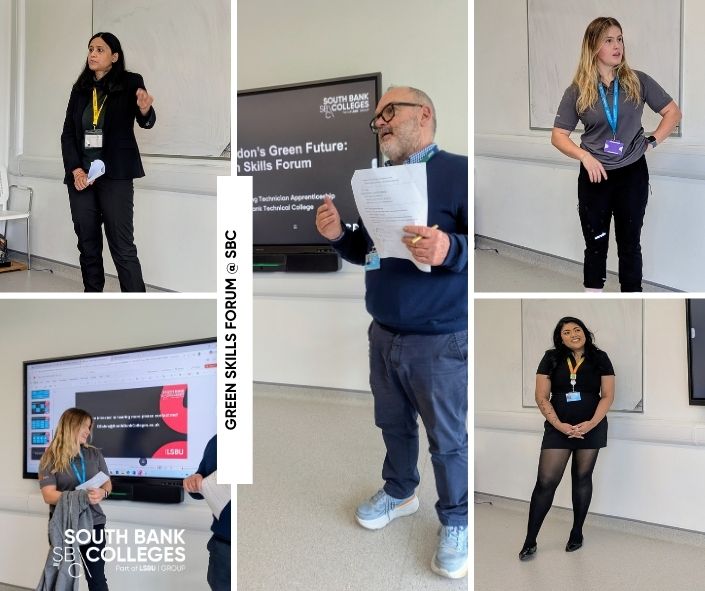
London South Bank Technical College welcomed employers, policymakers and industry leaders on 26 February 2026 for its latest Green Skills Forum — a focused, forward-looking conversation about how London builds the workforce it needs for a net zero future.
From heat pumps to hydrogen, from apprenticeships to industrial strategy, one message echoed throughout the morning:
The green transition is not coming. It is here. And the skills must keep up.
Setting the Stage for a Greener London
Principal Craig Hamilton-Smith opened the forum by reaffirming the college’s commitment to leading technical education within the LSBU Group.
The college has invested significantly in renewable technologies training and is already delivering one of the country’s pioneering Low Carbon Heating Technician Apprenticeships. With live borehole ground source heat pump systems, air source heat pump workshops and newly developed F-Gas training rigs, students are learning in facilities designed for real industry demand.
Director Tim Weston highlighted how the college is already at the forefront of delivery, working directly with employers and training partners to shape the curriculum in real time.
But a critical question remains: If the infrastructure is ready, why is apprenticeship uptake still lower than traditional plumbing and heating routes?
The forum set out to explore exactly that.
Industry Speaks: The Skills Gap Is Real
Representatives from Quantum Training, Daikin and NOCN Group outlined a clear and pressing challenge.
Demand for low-carbon heating systems is rising sharply across the UK. Yet the workforce pipeline is not expanding at the pace required.
Daniel Jackson, Head of Training UK at Daikin, explained that manufacturers are ready — but installer numbers are not yet sufficient to meet long-term targets. Awareness, he noted, is part of the issue. Many young people simply do not understand what renewable technologies involve or how diverse the career pathways can be.
The message from industry was clear: The opportunity is enormous. The workforce needs accelerating.
Government Strategy: Clean Energy at Scale
Amrita Sinha Kataria, Senior Policy and Engagement Manager at the Department for Energy Security and Net Zero, outlined the government’s Clean Energy Jobs Plan and Warm Homes strategy.
Key ambitions include:
-
Expanding the clean energy workforce significantly by 2030.
-
Supporting workforce transition from traditional oil and gas sectors.
-
Ensuring high-quality, long-term employment opportunities.
-
Driving regional growth through local skills planning.
Current projections indicate that the UK will require approximately 12,000 heat pump installers by 2030 to meet demand. Achieving this will depend on coordinated action between government, industry and training providers.
Forums like this one are a vital part of that coordination.
Engineering Construction and the Bigger Workforce Picture
Sam Green from the Engineering Construction Industry Training Board added perspective from across engineering construction and infrastructure.
While many core skills required for renewable technologies already exist within the workforce, a significant proportion of experienced workers are due to retire within the next decade. This creates both urgency and opportunity.
The challenge is not only to train new entrants, but to manage the transition of existing expertise into emerging sectors.
Apprenticeships: Clarity and Opportunity
Apprenticeship Manager Bavan Datta provided practical clarity for employers considering low-carbon apprenticeships.
The structure is straightforward:
-
One day per week in college, four days in the workplace.
-
Government funding covering up to 95–100% of training costs for non-levy employers.
-
Incentives available for younger apprentices.
-
Free recruitment support provided by the college.
The pathway is not just about installation skills. Apprentices gain a broad range of certifications, including gas, electrical competencies, health and safety, and renewable technologies — creating highly versatile professionals.
The Apprentice Perspective: Why Messaging Matters
The highlight of the morning came from Low Carbon Heating Technician apprentice Connie Pawsey, who offered an honest and refreshing perspective.
She spoke about how young people often “fall into” careers rather than plan them, and how renewable technologies are rarely presented as exciting or visible options during school years.
Her insight was direct: Young people need to see these careers as modern, skilled and empowering — not niche or technical afterthoughts.
She also emphasised the importance of diversity in the sector and her ambition to build an all-female renewable installation business in the future.
Her message to employers and educators was simple: Make it visible. Make it aspirational. Make it clear.
From Discussion to Action
Across the panel discussion and Q&A, several themes emerged:
-
Awareness of low-carbon careers must start earlier.
-
Employers need clarity on apprenticeship structures and funding.
-
Curriculum must align closely with real-world installation needs.
-
Underrepresented groups represent significant untapped potential.
-
Collaboration across industry and education is essential.
The forum concluded with agreement to reconvene on 18 June 2026, ensuring momentum continues.
A Practical Demonstration of the Future
The event closed with a guided tour of the college’s renewable and heat network training facilities, including:
-
Ground Source Heat Pump workshops linked to a live borehole.
-
Air Source Heat Pump systems.
-
Dedicated F-Gas training rigs.
It was a tangible reminder that London South Bank Technical College is not preparing for the future - it is actively building it. As the clean energy transition gathers pace, one thing is certain: Skills will determine success.
And here at London South Bank Technical College, those skills are already taking shape.