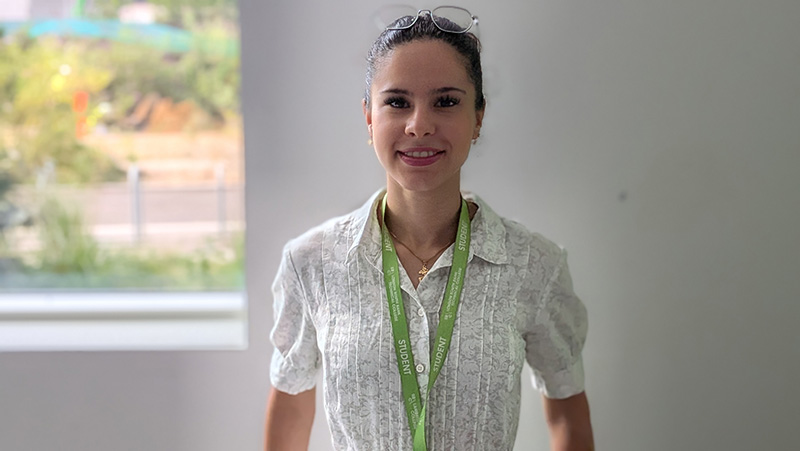
For Niloufar, completing her course at London South Bank Technical College is not the end of her South Bank education. It is the next step along a connected route that will take her from college into higher education at London South Bank University.
After completing the Access to Higher Education Diploma in Medicine and Dentistry at the college’s Nine Elms Campus, Niloufar is preparing to progress to an Operating Department Practice degree at LSBU.
Her journey demonstrates one of the central benefits of studying within the LSBU Group: students can begin at the level that is right for them, build their academic skills and confidence, and then progress towards university and a professional career while remaining part of the same wider educational community.
“My heart was with London South Bank University,” Niloufar said. “Because I studied at the college, I thought that maybe I would continue to the university. Mentally, it felt more accessible to me, and it was.”
A demanding course with an achievable destination
Niloufar describes the one-year Access to Higher Education course as intense, particularly when examinations and assignment deadlines gathered together during the winter.
However, she also found that its mixture of examinations and coursework gave students more than one opportunity to demonstrate their knowledge.
“The good thing about the Access course is that it is not all based on examinations,” she explained. “There are assignments as well, so if you do not do well in an examination, you still have the chance to do your best in an assignment.”
Her advice to future students is reassuringly direct: the course requires commitment, but strong results are achievable.
“It is intense, but it is possible. It is even possible to achieve distinctions in all the units if you really work hard.”
For students considering an Access course, this is an important point. It is designed as a serious route into university-level study, particularly for people who may not have followed a traditional A-level pathway. Students should expect a busy year, but they will also be building the study habits, scientific knowledge and confidence needed for higher education.
Lecturers who know when to explain something again
Niloufar credits much of her success to the support she received from her lecturers in physics, biology and chemistry.
Her physics lecturer carefully explained the assessment criteria and worked individually with students to identify their strengths and areas for improvement. One-to-one review sessions helped Niloufar understand where she was progressing well and where she needed to focus her effort.
The biology lecturers brought different personalities and teaching styles to their units, but Niloufar felt that the staff and students worked together closely.
“It did not feel as though there was a big gap between us,” she said. “We could feel that we were a team.”
Chemistry presented its own challenges. Niloufar cheerfully admits that the subject stretched her, but the lecturer made difficult material easier to approach by being patient, supportive and entertaining.
“He explained everything over and over again whenever we said we did not understand,” she said. “The teachers were the number-one part of the course.”
That relationship between students and teaching staff is especially important on an intensive Access programme. Progress does not always arrive in a straight line. Sometimes it requires another explanation, a different example or a lecturer who notices that a student has not quite grasped a key idea.
Seeing university as a real next step
Students on the course also had opportunities to meet representatives from universities and ask questions about degree options, entry requirements and progression.
For Niloufar, this helped turn university from a distant ambition into a practical next step.
Access qualifications can open many doors, but not every university course has identical entry requirements. Speaking directly to university representatives helped students understand which courses were available to them and what additional qualifications or experience they might need.
The connection between South Bank Colleges and LSBU made this transition feel particularly natural. Niloufar had already spoken to another student who studied engineering at the university and sometimes attended shared activity at the college.
She had also visited LSBU facilities and discovered that she could gain early access to the university gym, which was especially welcome because she is an athlete.
Remaining in the local area was another major advantage. Studying close to home can reduce travel and accommodation costs while allowing students to maintain employment, friendships and family commitments.
“I did not want to travel to another city because it would be expensive,” Niloufar said. “The course is going to last for several years, and I did not want to be moving around.”
Preparing for enrolment
Niloufar’s experience also offers some valuable lessons for students preparing to enrol at South Bank Colleges.
Originally from Iran, she arrived in the UK with an Iranian high-school diploma and experience of studying pharmacy at university. She already spoke English, having studied it for more than ten years, but needed qualifications that would be recognised by UK colleges and universities.
She completed Functional Skills English at Levels 1 and 2 before taking IELTS, where she achieved an impressive score of 7.5 on her first attempt.
Niloufar also needed evidence explaining how her Iranian qualifications compared with the UK education system. Although her diploma had been translated into English, she still needed a formal comparability statement. This became an issue during enrolment because that additional document was still being processed.
Niloufar eventually joined the course with help from college staff, including a member of staff who understood the Iranian education system and was able to explain her qualifications to colleagues. Nevertheless, she advises students with overseas qualifications to investigate the requirements as early as possible.
Students coming to enrol should check carefully which documents are required for their chosen course. Depending on their circumstances, these may include original qualification certificates, examination results, proof of identity, evidence of English-language ability and officially translated or assessed overseas qualifications.
It is also worth contacting the college before enrolment if any document is missing, still being processed or difficult to obtain. Asking early can prevent a small piece of paperwork from becoming an issue on a busy and full enrolment day.
Support beyond the classroom
Niloufar’s year was not only academically demanding. She also worked three days a week in a charity shop while attending college on Mondays, Tuesdays and Thursdays.
Her timetable gave her Wednesdays for independent study and personal time. This made the combination manageable, although she later reduced her responsibilities at work to prepare for the greater demands of university study.
She also made use of several practical college services.
The laptop loan scheme allowed her to borrow equipment from the library when she had not brought her own computer. This was particularly helpful because she often cycled to college and did not always want to carry a heavy laptop.
College computers and large screens provided additional places to complete assignments, while printing credit helped students produce their coursework without paying commercial printing costs.
During a particularly demanding period, Niloufar was also referred to Student Services and received regular counselling support.
“I could talk to someone who would sit and listen to me,” Niloufar said. “She also gave me guidance when I asked what she thought. It was a great help.”
For new students, asking for support will never be seen as a sign that they are failing. Academic guidance, wellbeing services, equipment loans and practical assistance are all there to help students remain on course and fulfil their potential.
Friends made along the way
College also brought Niloufar friendships that extended beyond the classroom. Her classmates ranged in age from around 18 to people in their thirties. Although she did not become close to everyone, she formed a strong friendship with a student who travelled from Brighton each day.
The pair regularly studied together in coffee shops. On one occasion, Niloufar travelled to Brighton so that they could spend the day preparing for a biology examination.
“The college has given me new friends,” she said. “She is now one of my best friends.”
That sense of connection matters. A demanding course becomes far more manageable when students can revise together, exchange advice and remind one another that everybody can occasionally find one subject challenging.
One connected route towards a career
At LSBU, Niloufar expects her degree to combine university teaching with substantial professional placements, potentially within the NHS.
It is the next stage of a journey that has already taken her across countries, education systems and subject choices. Along the way, she has gained recognised English qualifications, completed an intensive science-based Access course, balanced study with employment and prepared for a career in healthcare.
Her story captures what integrated education within the LSBU Group can offer.
The route from college to university does not have to feel like a leap across a canyon. With the right course, guidance and support, it can become a series of achievable steps, each one building upon the last.
For students arriving at South Bank Colleges for enrolment, the immediate priority may be choosing a course, checking certificates or navigating the paperwork. However, Niloufar’s journey shows the larger destination that can lie beyond that first day.
A student may enter Nine Elms carrying a folder of documents and a head full of questions. A few years later, that same student could be progressing through LSBU towards a degree, a professional placement and a new career.
For Niloufar, that next chapter is now about to begin.